Showing posts with label family and home. Show all posts

Wednesday, July 20, 2016

DAD'S STUDIO - PRINTER'S LOUPE

One of the objects I kept when dismantling my Dad's studio was this brass printer's loupe, made in Germany. I quote here Wikipedia's description, for those who may not be familiar with this device:
"A loupe (pronounced 'loop') is a simple, small magnification device used to see small details more closely. Unlike a magnifying glass, a loupe does not have an attached handle, and its focusing lens(es) are contained in an opaque cylinder or cone, or fold into an enclosing housing that protects the lens when not in use. Loupes are also called hand lenses."

A printer's loupe is usually small---this one, when folded up, is about the size of a large postage stamp.
Opened, it holds the lens at the correct distance for focusing on a detail of a printed page. This built-in positioning eliminates having to fuss with and adjust the position of the lens while also trying to inspect the printed image.
Place the opened loupe on the printed area, and by then looking through the top of it...
...it is possible to see the dot pattern that makes up an offset reproduction (the usual technique by which most images are reproduced today), as well as other details. Being able to look at the printed area so closely helps with color correction, and with improving the overall reproduction.
When finished, fold it up and tuck it away for the next time.This loupe probably originally had a fitted leather case in which to store it--now lost. Loupes are still being made, and some of them are more complex than this one. But the modern loupes are plastic, and aren't always designed to fold up. I love the heavy solid feel of this little brass version, its collapsibility, and the fact that it did its job in Dad's studio for over 70 years.

Monday, June 6, 2016

DAD'S STUDIO - BRONZE POWDER

When I dismantled my Dad's studio earlier this year, I kept a few objects that had special meaning for me. One of them was this little tin of bronze powder. As a special treat for me when I was a small child, Dad would tip out some of this powder onto a china saucer, add banana oil to the proper consistency---and like magic, there was gold paint, ready for me to brush on as the final embellishment to an image I had created.
The tin is still half full...
...and the powder is still as sparkling and magical as it was when I was five years old. Just like the impact Dad still has, even after his death, on my life as an artist.

Monday, May 9, 2016

HIATUS

My last blog post was in January...the dead of winter. Four months later, spring is in full bloom. I've allowed a HIATUS, a time of silence...not something we creative people are supposed to indulge in, these days. The modern world, being of very short memory, demands to hear from us, about us, of us, every day---lest it forget us.  Like many of my colleagues, I do my best to comply. But the creative life does not always cohabit easily with daily self-proclamations. 

During these past four months, I put together a new book project---manuscript, dummy, and five spreads of finished art---which my agent is now peddling.

During these four months, I also closed down my summer studio. After years of commuting between two different work spaces, I was ready for the ease of having everything at hand, all in one place, all the time.

And during these four months, I finally sold the house and studio where my Dad (http://www.aldrenwatson.com) had lived and worked for thirty years. It was time for me to let go of his space, his presence, and his mentorship.
My hiatus has left me dis-encumbered, re-focused, with my potential book knocking at publishers' doors; and with a new book well underway on my desk. As to whether the world out there has forgotten me after my four months of silence---time will tell.
 

Friday, October 9, 2015

STEAM ENGINES

This is one of the double-page spreads I created for "The Cats In Krasinski Square", written by Karen Hesse, and published in 2004. It's a large piece, 24" wide, and executed in pencil, watercolor, and ink. The story was challenging to illustrate, set as it was in Warsaw, Poland, during WWII, and dealing with the hardships of Jews, both in and out of the Warsaw Ghetto.
Since the story was historical fiction, I relied heavily on photographs to construct my illustrations. When I had roughed out this composition, using xeroxes of photos and my own very rough figure sketches, I showed it to my dad, Aldren A Watson, the well-known illustrator who was my professional mentor until his death. Dad looked at my compostion for several minutes, clearly uncomfortable about SOMETHING. Finally he said, "You've got an American steam engine here, not a European steam engine." 
 As it happened, my father was not only a terrific artist, but an expert on old trains. (And just a note: I learned that American steam engines had cowcatchers at the front end; European engines had bumpers.) He sent me sketches, photos, and books of European steam engines, as well as historical information about the manufacturers of steam engines, indicating which kind of engine was likely to have been in Warsaw in 1940. Thank goodness he caught this mistake---I'm not sure if anyone else would have seen it until it was too late.
I began to revise my sketch. It was hard to find photos clear enough for me to see all the details of wheels, drive shafts, and other mechanical parts. "Just add a lot of steam" my Dad said. We artists know about "adding steam". Sometimes that's a cop-out; other times it's a practical solution. As my son always said about film and the stage (and equally applicable to illustration): "We're creating an illusion of reality, not reality itself."
On a separate transparent layer I next worked out very carefully the arrangement of the clouds and steam behind the engine.The separate layer avoids messing up any drawing on other sections of the compositions.
Next came the figures of the pursuers...
...and of the pursued.
I combined all these layers into my master sketch. I carry out this process with transparent vellum, but the process is exactly the same if one is doing it on a computer.
And voila (after 4 days of painting and inking)---the finished illustration. 

Monday, January 5, 2015

BEST SEAT IN THE HOUSE

The Best Seat In The House? This one---at my drawing board, paints and brushes at hand, Baroque guitar on the portable CD player. There's only one problem. I've been doing more writing (which always takes place on the living room couch) in recent months than drawing. So Kitty (he's asked that I not use his real name) has come to the conclusion that the Best Seat is HIS Best Seat. Now that I'm back to illustrating, Kitty and I have a little---make that a large---contest of wills each morning when I go to work.
Once evicted from the Best Seat (yes, I always win), the Second Best Seat (according to Kitty) is the one in front of the computer. Clearly a come-down. But this does not solve the problem. I have to use this seat as well, many times during the day, which means more contests of will.
After a second eviction, the Third Best Seat in the house is this one, arranged especially for Kitty, and a seat he'll never have to share with me. Its drawbacks? Location ... size ... view ... plus it's never conveniently warmed up ahead of time by someone else's posterior.
The conclusion that I draw from all this? That Kitty is an especially intelligent being. He understands the true priorities of life. As I compose this blog post, opportunistic Kitty, surrounded by paints and brushes and the music of Bach, is settling down into ... the Best Seat In The House.


Tuesday, December 30, 2014

TO CENSOR OR NOT TO CENSOR

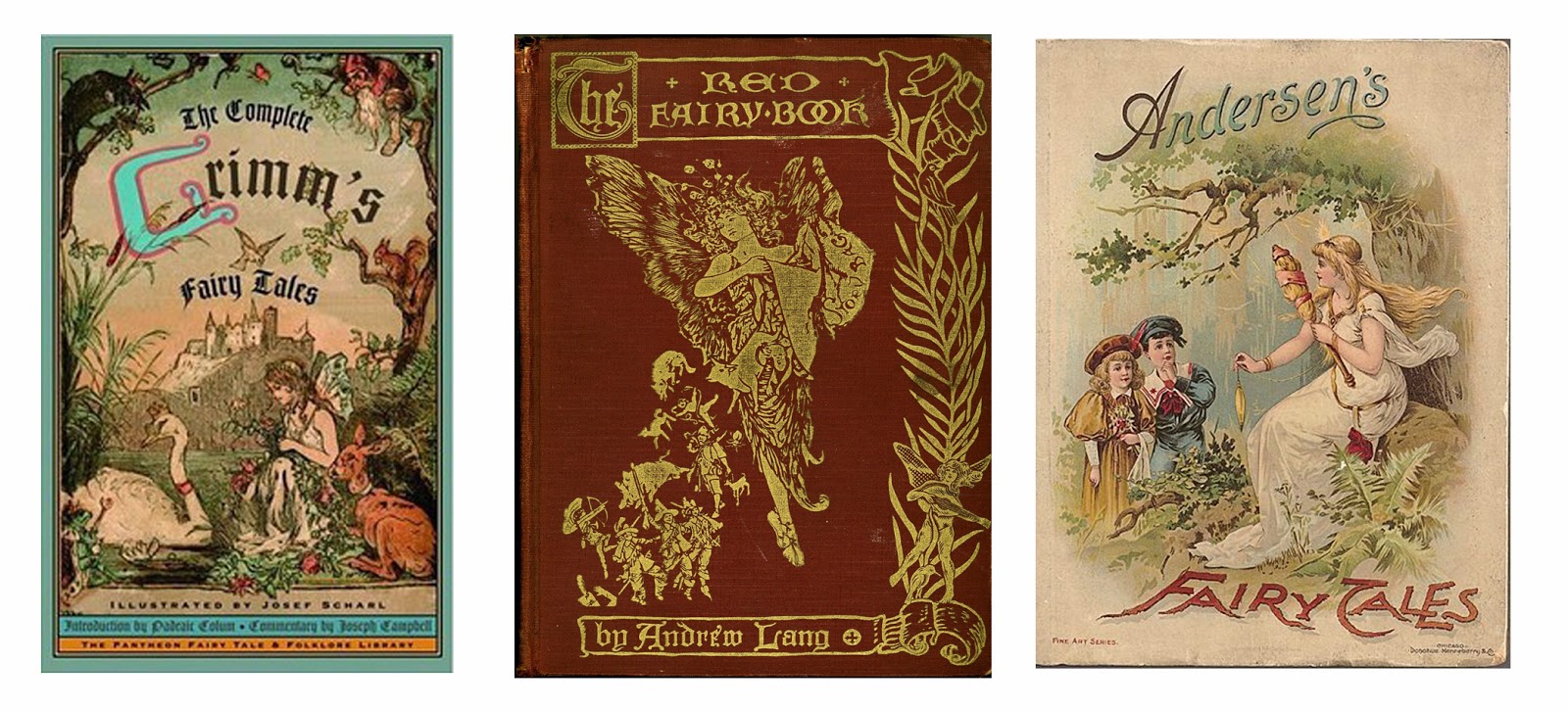
 I won't dive in to the deep waters of the discussion over whether to censor traditional fairy tales for young readers---whether to take out the gruesome or scary parts, whether to make sure they have morally correct endings, and so on. That discussion has been carried on by life-long students of literature, child development, mythologies, and the like; and it began with the very first publication of the Grimm's brothers collection in 1812---or even earlier. I would be in way over my head if I joined this group.
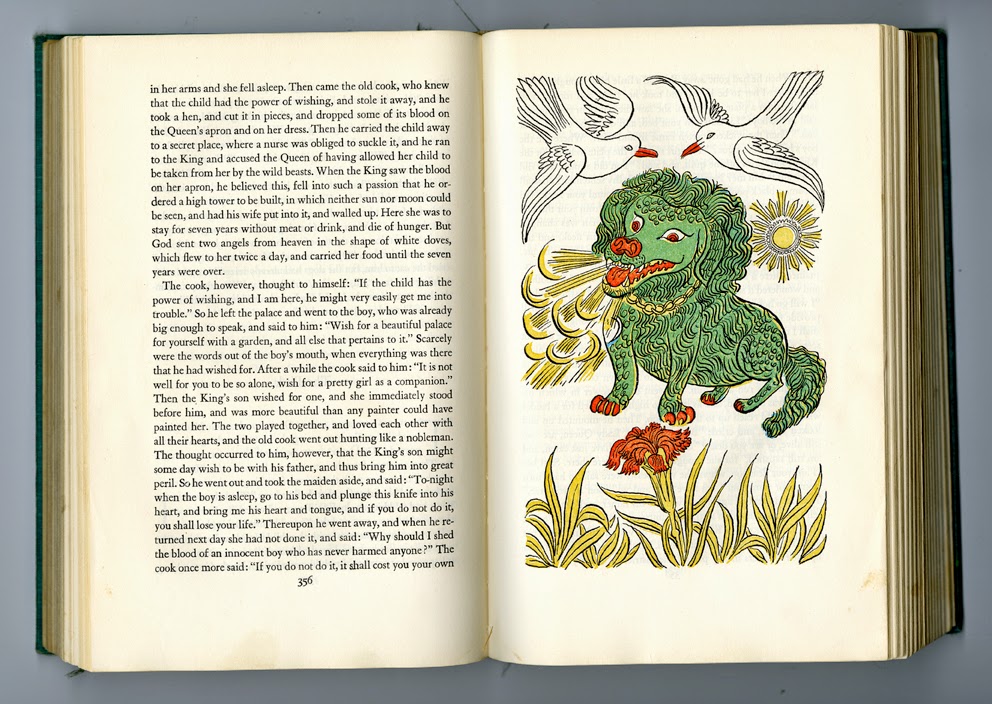
from "Grimm's Fairy Tales, Complete Edition, illustrated by Josef Scharl"
But I can dabble here in the shallows, and talk about my own experiences with fairy tales. 
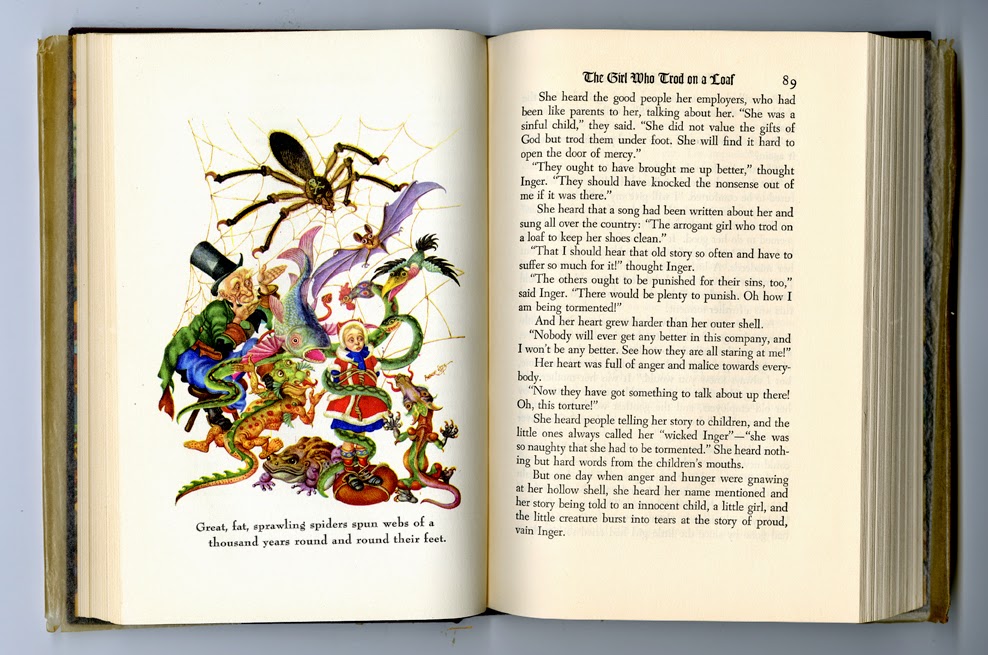
from "Andersen's Fairy Tales", illustrated by Arthur Szyk

As a child, I read voraciously. I took armfuls of the books I had chosen out of the public library; and I read and re-read the volumes that filled the bookshelves and cluttered the rooms in our home. Fairy tales were one of my main staples.
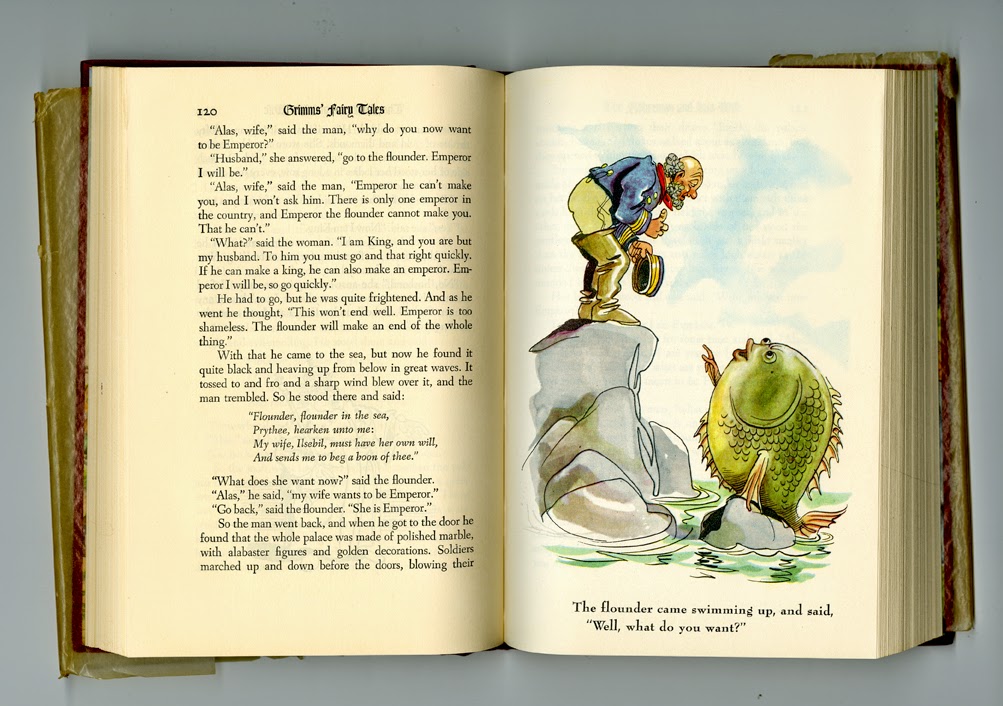
from "Grimm's Fairy Tales," illustrated by Fritz Kredel
As a child, life could be bewildering, confusing, hurtful; even terrifying. I didn't consciously realize it then, but I know now that immersing myself in fairy tales helped me to navigate the turbulent parts of my days---to integrate all those contradictory parts into a cohesive whole.
Paper Sculpture, by Su Blackwell http://www.sublackwell.co.uk/#
I am glad that my parents did not try to control what I read. I am glad that I had access to the magic, symbolism, metaphor, and mythology of uncensored fairy tales. I was too young to understand logical and intellectual explanations about life, but I could understand the messages embedded in fairy tales. Fairy tales: for me, a treasure-house of wisdom. 

Tuesday, December 9, 2014

IS THAT TRUE?

When my son was around 4 years old, he tagged along with me as I attended a short conference on storytelling. One of the traditional tales told was The Big Toe (http://www.creativetales.net/the-big-toe#.VHuEg0vtVt0). The storyteller was quite skillful, building up the tension with increasing volume, and manipulating his voice to ominous effect. He finished up with appropriately creepy groans and the final phrase, "You've got it!"---making all of us in the audience jump in delighted surprise. James enjoyed the telling right along with the rest of us. Next came Q & A. The audience asked about storytelling techniques, how to keep your audience's attention, and so on. Then James raised his hand.

"Was that a true story?" James asked.

The storyteller thought for a moment. Then he said to James, "There are Factual Events; and there are True Stories. This story wasn't a Factual Event; but it is a True Story." 

James listened; nodded his head. He understood completely. And I have never forgotten those words of wisdom from this storyteller. Isn't that what we artists are working with, always? The True Story---which may or may not be a Factual Event.

Note: In this day and age I feel compelled to defend my parenting techniques, in case readers think that a 4-year-old should not have been exposed to a creepy telling of a creepy story. My children---who both learned to read before they were five---read anything they wanted, including gruesome Grimms Fairy Tales, gruesome Mother Goose rhymes, and all those other pieces of literature from which children today are so often protected. I often remember what James---and I, too---learned about the difference between Facts and Truths from that performance, and how succinctly and clearly it was demonstrated to him. How fortunate my son was, to learn this at such an early age.


Sunday, November 30, 2014

A STONE IN THE BEANS

This morning I was preparing dried beans for baking, and found amongst them a good-sized stone. "Ah," I thought, "there must some connection between a stone in the beans, and art-making." All through breakfast I toyed with this idea. Finding a stone in the beans was like...finding a mistake in my spelling? Finding a clumsy line in my drawing? No, the stone in the bean wasn't just a mistake.  It was totally out of place. It could even be dangerous---if an unwary diner bit down on it with tooth-cracking gusto. So---the stone was like a flourescent color in a painting of pastels? Or like a brand-new character suddenly popping up at the end of a story---so jarring that an editor would reject the entire project out of hand?

Bother! I couldn't come up with anything I liked. Besides which, it was time to put the beans into the oven and sit down at my drawing board. So there's no moral or piece of wisdom attached to this posting. Except...

Sometimes a stone in the beans is . . . just a stone in the beans. 

As a consolation prize, here's my mother's baked bean recipe, slightly altered by me:

MOM'S BAKED BEANS

Soak 1 pound Maine Soldier beans overnight in plenty of water. The next morning, drain them well, discarding the soaking liquid. Cover with fresh water, bring to a boil, and simmer until the skins of the beans split when you remove a few from the pot and blow on them. Put a peeled, quartered (or chopped up, if you wish) medium-sized onion in the bottom of the bean pot. Strain out the beans from the water and add them to the pot. Pour over the top 1/4 cup maple syrup, 1/4 cup olive oil, 1 teaspoon ground mustard, and 1/4 teaspoon black pepper. Add enough hot cooking liquid to reach the top of the beans. Cover and bake for 6 hours at 300, adding boiling cooking liquid or boiling water occasionally to keep the liquid near the top of the beans. 

For Mom's version, omit the olive oil; instead lay a chunk of salt pork, fat side up, on top of the beans before you put the pot into the oven.


Wednesday, June 4, 2014

JUNE POSTER

I've always loved mice.  As a child I listened to their nightime whisperings as they scurried within the double walls of our old brick house.  When as an adult  I moved from one house to another, it seemed mice were always there. I could not resist sharing this poster today.  It's based on my illustration from IS MY FRIEND AT HOME, Native American stories retold by John Bierhorst, and starring one of my favorite creatures. 

Download for printing at: http://www.wendy-watson.com

Monday, March 31, 2014

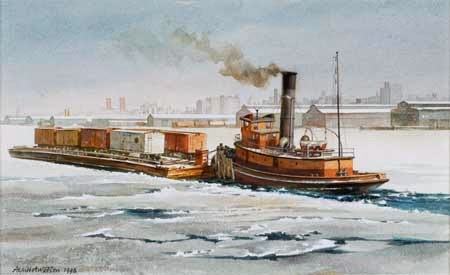
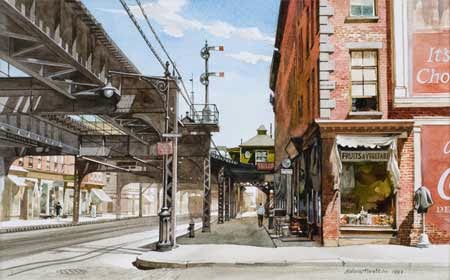
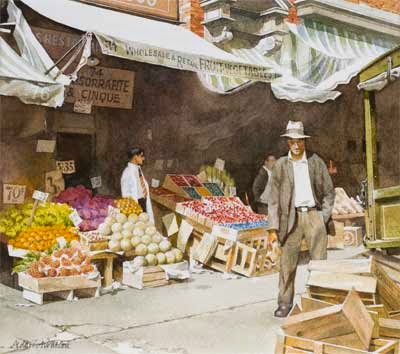
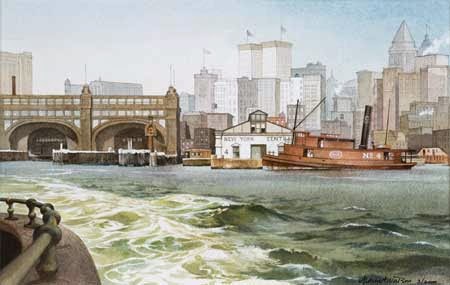
ALDREN A. WATSON'S FINAL OPUS: WATERFRONT NEW YORK

I talked about my father, Aldren A. Watson, and his final book, Waterfront New York: Images of the 1920s and '30s, in a previous blog post.(http://thewendywatsonblog.blogspot.com/2013/05/aldren-watson-1917-2013.html)

Many people have expressed to me their interest in obtaining copies of this book.  I'm happy to announce here its official publication, with information about pre-publication orders.

ANNOUNCING FALL 2014 PUBLICATION of
WATERFRONT NEW YORK, IMAGES OF THE 
1920S & ‘30S
WRITTEN & ILLUSTRATED BY 
ALDREN A. WATSON

PUBLISHED BY THE QUANTUCK LANE PRESS,
DISTRIBUTED BY W.W. NORTON & COMPANY

Forty-five watercolor paintings and five maps present an 
intimate view of the thriving port city of New York 
in the early 1900s. 
Detailed scenes of everyday life on and around the 
waterfront are rendered through the 
eyes of artist Aldren A. Watson, born and raised in Brooklyn. 
Paintings are accompanied by informative text 
and recollections drawn from 
the artist’s notebooks. 
Includes comprehensive index.
There will be 500 copies of Waterfront New York available 
at a discount if ordered in advance of the Fall 2014 
publication date. To purchase books at the special 
discounts listed, orders must be prepaid and received 
before September 15th. Books will be shipped as soon 
as they are received from the printer. Once published, 
the book will be available in bookstores for $35.00 each.


Aldren died in May 2013 without the pleasure of 
seeing this book in print. He had looked forward 
to signing copies, so in the spirit of that wish, 
a special bookmark that includes a reproduction 
of his signature will accompany each book 
purchased with this offer.

Prepaid single copies discounted to $30.00 each.
Additional copies discounted to $25.00 each.
Prices include media rate shipping 
for orders within the continental US.
Go to www.aldrenwatson.com for a downloadable 
order form, as well as author/artist biography, bibliography, 
and selected images from the book.
Inquiries can be addressed to 


Monday, December 30, 2013

THE SEASON OF LIGHTS - III

On Christmas Eve, the little church in the Vermont village I lived in always held a candlelight service.  When the service was over, many of us---whether traveling on foot or in vehicles---did our best to keep our candles alight for the trip home.  We wanted to carry our lighted candles ceremoniously into our houses; set them on our tables and our mantlepieces; light more candles from their burning wicks; preserve the light.  We guarded our little flames carefully during the journey.  They often succumbed to a gust of wind, or an inadvertent gesture.  Yet, always, at least one candle remained lit, and was there to pass its light back, and on, to the rest.
This is a Christian tradition, of course.  Yet the desire to bring light into the darkness, and love into sorrow, is universal, and is found in philosophies and beliefs all over the world.  During this time of the year, an old celestial cycle is ending, and a new one is beginning.  The lengthening nights have slowly turned, once again, toward the return of the light-giving sun.  Let's now grasp the light and love that is given to us, and take it with us.  Let's carry it into our homes, and into our hearts.

Tuesday, December 17, 2013

WHY I MAKE CHILDREN'S BOOKS

I published this book many years ago.  The children who were reading it when it was published are now in their 30's, their 40's, or perhaps even their 50's.  But even though the book is now out-of-print, it seems that it still lives on in the hearts of those who read it as a child.  Someone will tell me, "It was my favorite book when I was 5 (or 10, or 4, or 8, or....)."  A grandmother or grandfather writes, "My daughter/son loved this book, and now I want to give it to my grandchild."
Recently I had the opportunity to see the flyleaf of a copy of this book...
...and the flyleaf of another copy of this book.  A colleague of mine, seeing the same flyleafs, wrote, "These inscriptions are very moving, and renew my faith in the tender, sacred quality shared between children and those close to them through children's books.  Seeing these handwritten notes is quite touching.  Yes, all the work and effort put into creating good children's books is so worthwhile."  Could we, as writers and illustrators of books for children, leave behind any better legacy?

Thursday, December 5, 2013

THE SEASON OF LIGHTS - II

The Season of Lights, for me, is not only a serious time of year, but a magical one.  From my earliest memories, I imagined what other creatures might do when we nosey humans were not staring at them.  As I lay in bed at night waiting to fall asleep, I could hear the sounds of mice as they began their daily nocturnal activities within the sturdy walls of our old brick house.  I felt certain that they had their own everyday lives, just as I had mine.  I extended that conviction to all of the non-human world around me---our diary goats, the rabbits and woodchucks of the fields, even the spiders and ants industriously working in the garden.  I also was convinced that all that fauna must have their magical times, just as we humans had ours.  I created this piece of art, using pen and ink with watercolor, in memory of that childhood belief...a belief that I see I still hold in my child's heart.  I'm offering giclee prints of this image through my Etsy store:  https://www.etsy.com/listing/171933183/archival-giclee-print-magical-tree-free?ref=shop_home_active

Tuesday, December 3, 2013

THE SEASON OF LIGHTS

As days shorten, and dark nights lengthen, we humans turn to lights to mark the season.  Even more southern cultures---though they live amidst a more subtle change of seasons---celebrate with light, in anticipation of the return of longer days.  As for me, growing up in northern New England, where the winter nights are dark and endless---well, if I had lived in earlier times, I would have whole-heartedly participated in religious and magical rites designed to entice the sun to return to the frozen earth.  Instead, being a supposedly more modern creature, I've treated this topic often in my books.  One example is TALES FOR A WINTER'S EVE, which I created intentionally to honor the winter solstice as it would pass through my beloved rural Vermont community.
The sun setting over a frigid and snow-clad community was a signal to folk---animal or human---that it was time to scurry for home, warm hearths, and tasty stews.  But it was also a symbol and a reminder of the setting of one season, and the advent of another.  
It was a signal to settle in for the long winter to come---in burrows, nests, hollow trees, or clapboarded buildings---that were hopefully well-stocked with food and fuel.
Brief forays out into the darkness and cold added zest to the long waiting.
But there was always the blessed fire and light on one's return---where one could warm one's toes, sip hot cider, and tell stories to pass the time.
And at the very end of the day, we hoped that for everyone---furred, feathered, scaled, or naked---there was a cozy bed, a goodnight hug, and comforting dreams of the return to light and warmth.